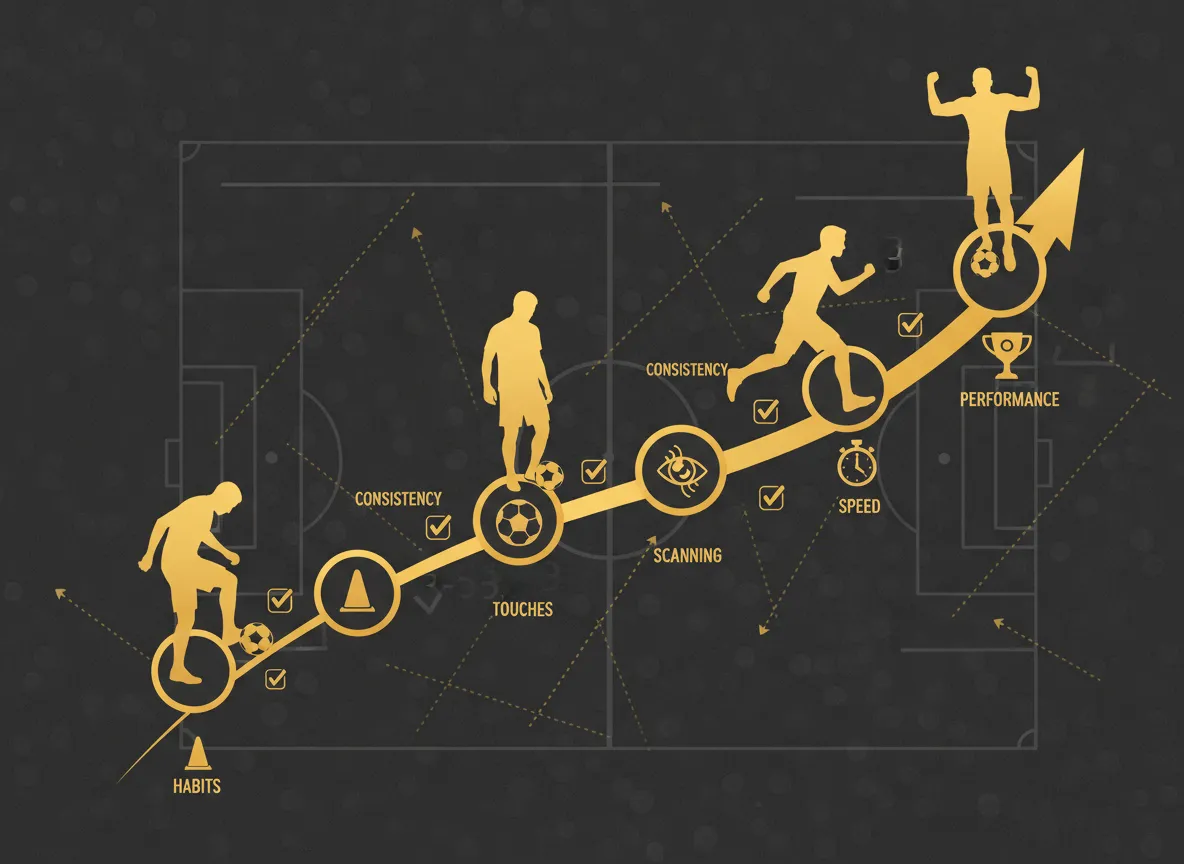
Habits Beat Hype — Consistent Training Develops Players
Huntsville families are being sold a shiny idea right now: “Join the right league and your player will level up.” DPL. MLS NEXT. ASPIRE. ECNL. New badge, new photos, new promises.
Here’s the truth:
Changing leagues doesn’t change your level. Development does.
A league can expose your level.
It cannot build your level.
Teams improve when individual players improve — and that only happens through consistent, intentional training.
The League-Hopping Problem
If a team isn’t competitive today, moving them into a different league usually does one thing:
It changes the address of the problem — not the problem.
If players can’t execute under pressure, solve game moments, win duels, keep the ball, and defend as a unit… the team is still the same team.
Just in a different league.
Don’t Buy the Badge Without a Blueprint
Before you commit to any “pathway,” ask one question:
What is the Player Development Plan for This Season?
A real answer should be clear.
If a club can’t explain that simply, the league name is doing the heavy lifting.
Bio-Banding: Development Tool or Business Tool?
Bio-banding is meant to support development by grouping players based on biological maturity (physical development), not just birth year — so late developers aren’t punished and early developers are properly challenged.
When organizations manipulate bio-banding to pull players down into younger age groups to win games, it stops being development and becomes roster engineering. That approach prioritizes trophies, rankings, and marketing over real player growth — and it turns a development tool into a business model.
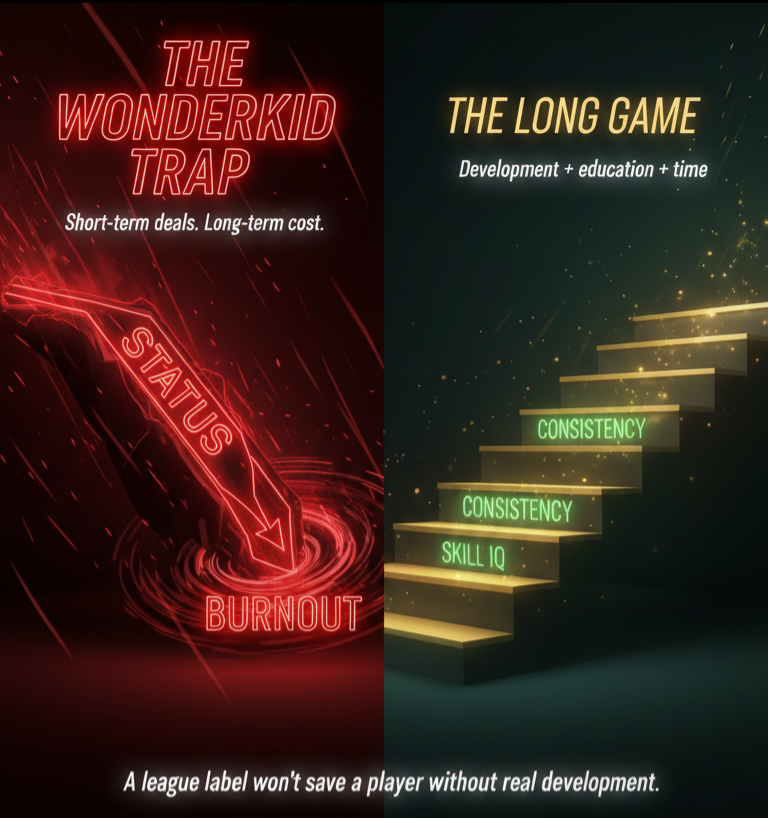
The Wonderkid Trap (Why Shortcuts Fail)
In the early stages of development, we have seen coaches prioritize short-term results — wins, team tactics, and what looks good to families — over true player development. It can satisfy the weekend scoreboard and even boost a resume, but it often costs the player long-term.
That’s why the “bigger and faster” player can look like a star at 9, 10, or 12 — and then fade later.
You’ve heard it before: “Just kick it long to Johnny — he’s bigger and faster than everyone.” That works… until it doesn’t. Eventually, other players catch up in size and speed. And when that physical advantage disappears, the question becomes unavoidable: what does Johnny have left?
Meanwhile, the smaller or less physically dominant players often have no choice but to build real foundations — first touch, ball mastery, decision-making, awareness, and problem-solving under pressure. Over time, those players grow, get stronger, and now they have both the physical tools and the technical/tactical base. They don’t just catch up — they pass the early “wonderkid.”
Then the same parents who loved the shortcut start asking why their child isn’t starting or getting minutes.
The hard truth is this: development gaps don’t show up immediately. They show up later — when the game gets faster, the players get bigger, and the margin for error disappears.
Fundamentals First, Tactics Second
Tactics can absolutely be taught later in a player’s career — but tactics will never consistently work without the foundation required to function inside a system.
A team can memorize patterns, press triggers, and rotations, but if players don’t have the underlying skillset — first touch, passing quality, scanning habits, decision speed, and composure under pressure — those tactics collapse the moment the game speeds up or the opponent applies real pressure.
In other words: tactics are the “how,” but fundamentals are the “can.” You can teach the “how” later. If you skip the “can” early, you spend years trying to build a house on sand.

What the Numbers Are Really Saying
The “pro pathway” is far less certain than most families are led to believe.
The graphic states 94%–96% of teen academy prospects are released before they ever sign a professional contract (University of Essex, 2024) — often summarized as “96% are ‘retired’ by age 21.”
Stop gambling your career on a 4% chance with no development plan in place. Choose development you can measure.
Arsène Wenger famously compares developing a footballer to building a house, focusing on four key stages. The philosophy prioritizes technical foundation (ages 7–14), followed by physical development (14–17), tactical understanding (17+), and finally, mental desire for success (18–19). Without technique at 14, he believes professional success is unlikely.
Whether the exact number is 94% or 96%, the takeaway for Huntsville families is the same:
If development isn’t real, the league label won’t save your player.
Final Word
Huntsville doesn’t need more league-chasing. It needs more player development.
If your team isn’t competitive, a new league won’t make you competitive. If your players aren’t improving, a new badge won’t make them improve.
If you’d like an objective development assessment of your player — where they are today and what’s limiting progress — contact us and we’ll outline the most effective next steps.
